The 5 Losing Strategies That Are Slowly Killing Your Relationship
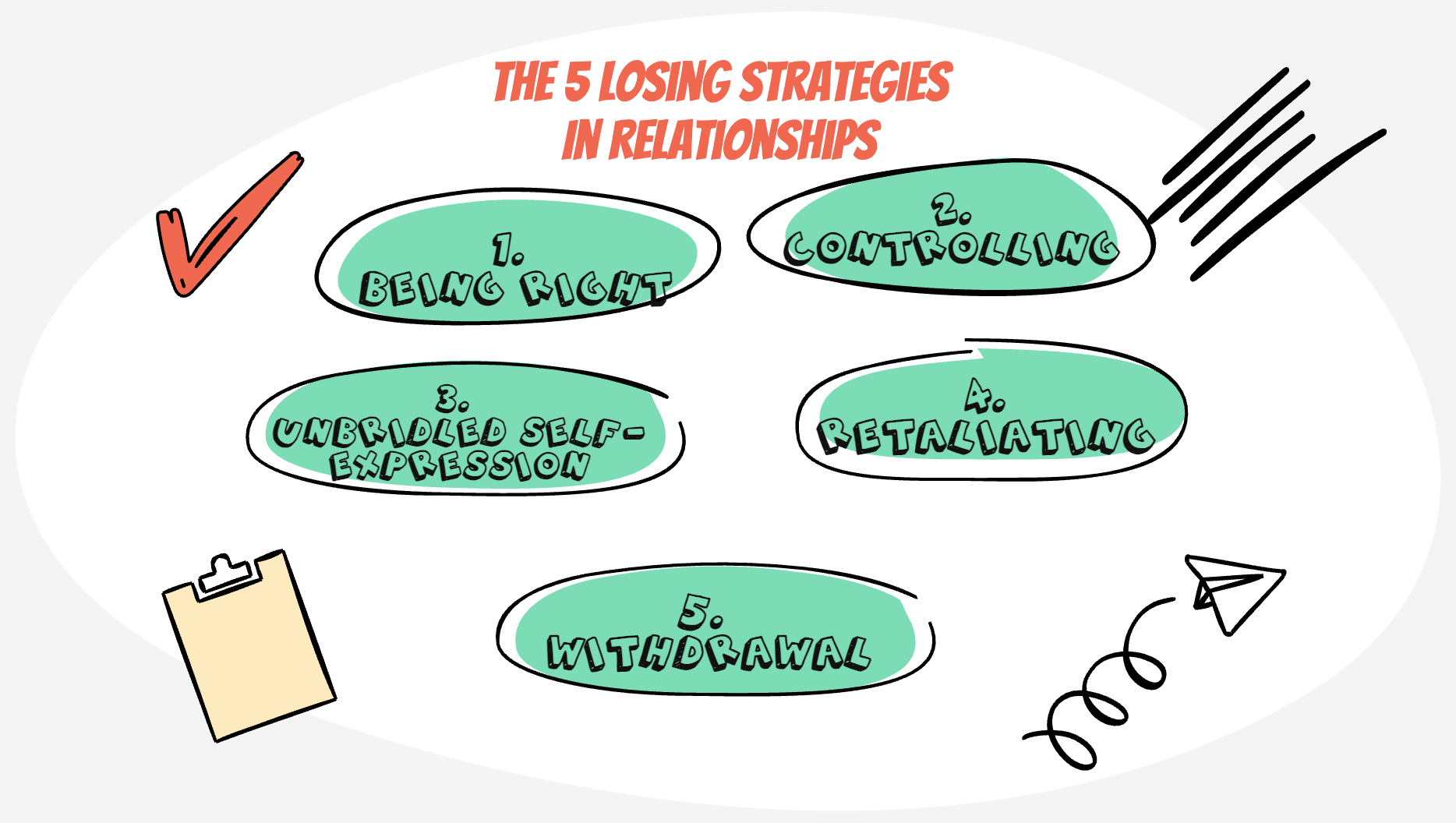
The 5 losing strategies identified in Terry Real’s Relational Life Therapy. Recognising your own are where the work begins.
You love each other. You're both trying. So why does every difficult conversation end the same way, with someone shut down, someone furious, and nothing actually resolved?
In Relational Life Therapy (RLT), developed by Terry Real, there's a name for the patterns that keep couples stuck: losing strategies. These are the moves your Adaptive Child makes when things get hard. They may have helped you survive your family growing up. In your relationship, right now, they are costing you everything.
The thing about losing strategies is they feel completely justified in the moment. That's what makes them so dangerous.
Here are the five losing strategies RLT identifies, and why each one is working against you.
1. Being Right
You know you're right. You have evidence. You have receipts. You have your sister's agreement and a podcast episode that backs you up.
None of that matters.
"Being right" means treating your relationship like a debate to be won. The RLT approach is direct about this: you can be right, or you can be connected. You cannot always be both. Objective reality has very little place in close personal relationships. Your partner doesn't need to be defeated. They need to feel like you're on the same team.
When "winning" becomes the goal, intimacy is the casualty.
2. Controlling
Control can look like obvious things: raising your voice, issuing ultimatums, making all the decisions. But it also hides in subtler moves, withdrawing warmth to punish, creating guilt trips, managing your partner's behaviour through emotional pressure.
Both are control. Both are losing strategies.
Controlling behaviour puts pressure on a partner to do or see things your way. It may produce short-term compliance, but it destroys long-term trust and connection. The partner on the receiving end eventually either explodes or shuts down entirely. Neither outcome is what you actually want.
3. Unbridled Self-Expression
Authenticity is important. Telling your partner every single thought that crosses your mind is not the same thing.
Unbridled self-expression is what RLT sometimes calls "kitchen-sinking", piling grievances on top of grievances, sharing every feeling without filter, offloading emotional weight onto your partner as though the relationship exists to absorb it.
People often justify this by saying they're "just being honest." But there's a difference between honesty and a lack of containment. What you say matters. How much you say, and when, matters just as much. A relationship requires a containing boundary, not a barf bag.
4. Retaliating
You were hurt. So you hurt back.
It feels logical from the inside. If you show your partner how it feels, maybe they'll understand. Maybe they'll stop.
They won't. RLT is clear that you don't make someone more accountable or empathic by hurting them. Retaliation, whether it's a direct verbal attack or the slow drip of passive-aggressive withdrawal, is "offending from the victim position." It keeps both of you locked in the same painful cycle, taking turns wounding each other and calling it communication.
5. Withdrawal
Withdrawal can look like the responsible option. You're not yelling. You're not retaliating. You're just... gone.
But withdrawal, whether you physically leave, go silent, or check out emotionally, is still a losing strategy. It communicates abandonment to your partner. It avoids the very conversations that could create real change. And when it's used as punishment rather than genuine self-regulation, it overlaps with retaliation.
Stepping away to genuinely regulate yourself is different, and healthy, but only when you come back. Withdrawal without repair is just disconnection with a calm face.
Why We Use Losing Strategies
Here's the important thing: you didn't invent these strategies. They came from somewhere. Most of them were adaptive at some point, ways you learned to manage difficult dynamics in your family of origin. Your Adaptive Child (a younger version of you) used them because they worked, or at least they helped you survive.
The problem is that the Adaptive Child is not running your marriage. Your Wise Adult needs to be.
In RLT, the goal is second consciousness: the capacity to recognise when you've been triggered into one of these patterns and make a different choice. Not suppressing your feelings, but choosing how you act on them.
The Good News
Losing strategies are learned. Which means they can be unlearned.
The five winning strategies in RLT offer a real alternative: advocate for yourself, speak to make things better, listen to understand, respond with generosity, and cherish what you have. They're not complicated. They are genuinely hard to do when you're activated. That's why couples therapy, and specifically RLT, exists.
If you recognise yourself or your partner in this list, that's actually a good sign. Awareness is the first step out of the dance.
Ready to stop the cycle?
At Couples Awaken, we work with couples in intensive RLT-informed sessions inspired by Terry Real’s work and integrating trauma modalities such as IFS and Brainspotting. These powerful and accelerated intensives are designed to shift patterns that have been stuck for years. Get in touch here.
Recognising the pattern is one thing. Knowing what to do in the moment is another.
If you've read this and thought "that is us", then Cassie can help you work out what to do next. She's a relationship coaching tool built on the RLT framework, available any time you need to think something through, reality-check a situation, or prepare for a conversation before it becomes another losing strategy moment.
Not sure if you're being right or being reasonable? That's exactly the kind of question Cassie is built to answer honestly.
Cassie is a coaching tool, not therapy. Created by Lucy Orton, relationship coach and registered counsellor (ACA #27921).