The 5 Winning Strategies That Actually Work in Relationships
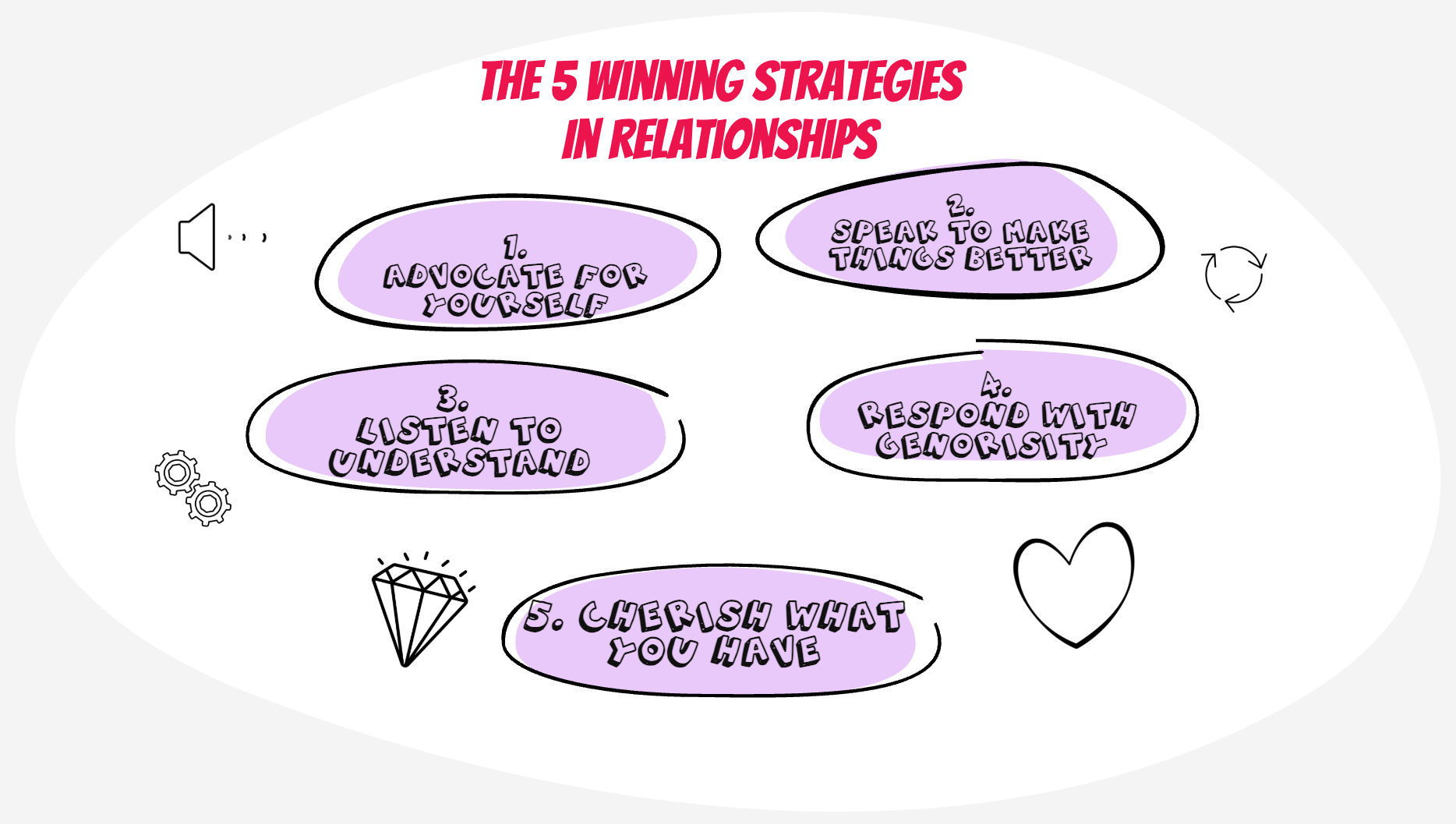
The 5 winning strategies from Terry Real's Relational Life Therapy, and why they're harder than they look.
Most couples don't fail because they stopped loving each other. They fail because nobody ever taught them how to fight well, repair well, or stay connected when things get hard.
In Relational Life Therapy (RLT), developed by Terry Real, the antidote to the patterns that keep couples stuck isn't just "communicate better." It's a specific set of five winning strategies, ways of showing up in your relationship that come from your Wise Adult rather than your Adaptive Child.
These aren't feel-good platitudes. They're a framework. And they're harder than they look.
1. Advocate for Yourself
Healthy relationships require two people who are willing to speak up for what they need. Not demand it, not manipulate for it, not hint at it and hope their partner picks it up. Ask for it. Directly, clearly, and with love.
This is harder than it sounds for a lot of people. If you grew up learning that your needs were too much, or that asking created conflict, or that the safest thing was to stay small and not rock the boat, advocating for yourself will feel uncomfortable. It might even feel selfish.
It isn't. In RLT, the goal is relational empowerment, not individual empowerment. You're not advocating for yourself at your partner's expense. You're bringing your whole self into the relationship so there's actually someone real for your partner to connect with.
You cannot have genuine intimacy with someone who never tells you what they want.
2. Speak to Make Things Better
There's a version of honesty that's really just an unburdening. Getting things off your chest. Making your partner understand exactly how wrong they were and how much it cost you.
That's not this.
Speaking to make things better means asking yourself, before you open your mouth: is what I'm about to say going to move us toward connection or away from it? It means shifting from complaints, which are focused on the past and on what your partner did wrong, to requests, which are focused on the future and on what you actually want.
RLT is specific about language here. Short, clear statements from the "I." Not "you always" or "you never." Not a list of grievances dating back three years. One thing. Said with love. Said with the relationship as the goal.
If something is important enough to bring up, it's important enough to bring up well.
3. Listen to Understand
Most people, when their partner is speaking, are doing one of a few things: waiting for a gap so they can talk, scanning for the thing they need to defend against, or composing their rebuttal in real time.
None of that is listening.
Listening to understand means genuinely suspending your own point of view long enough to get curious about your partner's experience. Not agreeing with everything they say. Not abandoning your own perspective. Just being willing to let them land before you respond.
This is one of the most underestimated skills in any relationship. When people feel truly heard, their nervous system calms down. They become less reactive, less entrenched, less defensive. You don't create connection by making your point better. You create it by making your partner feel less alone.
The goal is connection, not objective reality.
4. Respond with Generosity
This one asks something real of you.
When your partner comes to you with a hurt, or a request, or a complaint, your Adaptive Child will have a very clear response queued up. It will want to defend, deflect, retaliate, or shut down. It will point to everything your partner has done wrong as justification for not giving them what they're asking for.
Your Wise Adult knows better.
Responding with generosity means thinking ecologically about your relationship. RLT uses this word deliberately: your relationship is a biosphere. If one of you wins and the other loses, you both lose, because the loser will make the winner pay for it eventually. Generosity isn't weakness. It's enlightened self-interest.
This also includes what RLT calls relational jujitsu: when your partner comes at you with a dysfunctional move, instead of meeting it with one of your own, you lean in with something unexpected. Warmth. Curiosity. Accountability. It disarms. It changes the dance.
5. Cherish What You Have
This is the one that's easiest to skip when things are hard, and the one that matters most for the long term.
Research by John Gottman, referenced in the RLT framework, shows that healthy relationships need a ratio of roughly five positive interactions for every negative one. Not because conflict is bad, but because connection has to be actively maintained. It doesn't run on its own.
Cherishing means noticing what's good. It means telling your partner specifically what you appreciate, not just assuming they know. It means celebrating the progress they're making, even when it's not everything you asked for. Especially then.
In RLT, there's a concept called relational reckoning: am I getting enough of what I need in this relationship to grieve what I'm not getting? That's mature love. Not the hormonal high of early romance, but knowing love: where you see your partner clearly, flaws and all, and choose them anyway.
Cherishing is what keeps that choice feeling worth making.
Why Winning Strategies Feel Hard at First
If these strategies feel obvious in theory and nearly impossible in practice, that's not a character flaw. It's neurobiology in action.
Your Adaptive Child developed its losing strategies over years, often decades. Those neural pathways are fast, well-worn, and automatic. Your Wise Adult's responses are slower, newer, and require a brain that isn't flooded with stress.
RLT is honest about this: it takes about three to four weeks of consistent practice for a new neural pathway to fire reliably. And two to three years of deliberate practice for a new way of responding to become a genuine trait. Brain change equals character change. It's real, and it's possible, but it requires showing up for it.
That's what couples therapy is for.
The Shift From Losing to Winning
The five losing strategies and the five winning strategies map almost directly onto each other. Being right becomes listening to understand. Controlling becomes advocating with love. Unbridled self-expression becomes speaking to make things better. Retaliation becomes responding with generosity. Withdrawal becomes cherishing what you have.
You already know how to do the losing version. The winning version is a choice, made again and again, from your second consciousness.
That's the work. And it's worth it.
Want to learn these skills with support? At Couples Awaken, we work with couples in intensive RLT-informed sessions that create real, lasting change in a fraction of the time of weekly therapy. Find out more here.
Knowing the winning strategies and actually using them under pressure are two very different things.
Cassie can help with the gap. She is a relationship coaching tool built on the RLT framework — somewhere to work through what a winning strategy would actually look like in your specific situation, with your specific partner, before the next difficult conversation.
Not sure whether you're advocating for yourself or just demanding? Whether you're speaking to make things better or just unburdening? Cassie will give you an honest read.
Cassie is a coaching tool, not therapy. Created by Lucy Orton, couples coach and registered counsellor (ACA #27921).